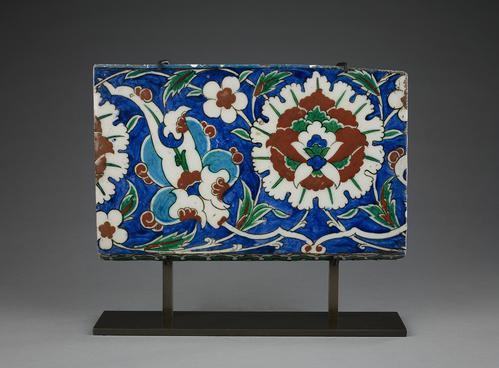
AKM875, Tile
© The Aga Khan Museum
Click on the image to zoom

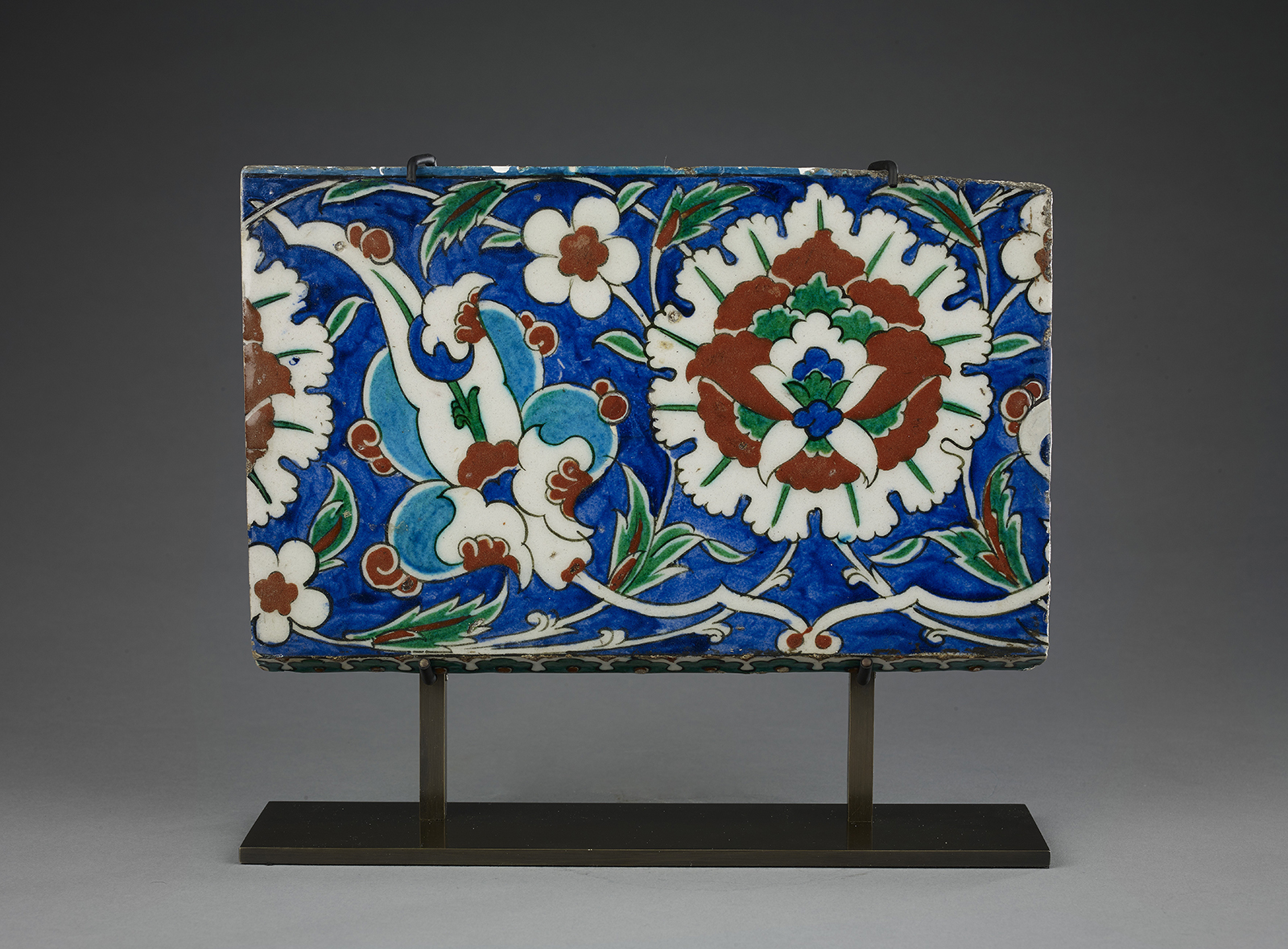
Tile
- Accession Number:AKM875
- Place:Turkey, Iznik
- Dimensions:24.5 x 15 cm
- Date:1560-1565
- Materials and Technique:Fritware, underglazed and painted
The Ottoman court valued the small city of Iznik for its tile production. Archival evidence reveals that, on more than one occasion, court officials brought Iznik workshops to task for selling tile shipments intended for the court to merchants instead. [1]
This tile, produced in the final years of Sultan Süleyman’s life, offers an example of the exuberant style that emerged in the late 16th century under court atelier director Kara Memi (a talented pupil of Shah Qulu). Memi inspired floral-infused compositions covering the surfaces of tiles, the mixing of non-figurative motifs, and a whole new range of colours. On this tile from the Aga Khan Museum, large stylized composite blossoms with serrated saz leaves combine with delicate arabesques, graceful branches in bloom, rumis, and palmettes. Its broad palette of colours encompasses white slip, red, blues, and bold emerald green.
- Filiz Çakır Phillip
Notes
1. Atasoy, Nurhan Atasoy and Julian Raby. Iznik: The Pottery of Ottoman Turkey (London: Alexandri Press, 1989), 118; also quoted by Hülya Bilgi, Dance of Fire: Iznik tiles and ceramics in the Sadberk Hanım Museum and Omer M. Koç collections (Istanbul: Vehbi Koç Foundation, 2009), 28.
References
Atasoy, Nurhan and Julian Raby. Iznik: The Pottery of Ottoman Turkey. London: Alexandria Press, 1989. ISBN:9781856690546
Bilgi, Hülya. Dance of Fire: Iznik tiles and ceramics in the Sadberk Hanım Museum and Omer M. Koç collections. Istanbul: Vehbi Koç Foundation, 2009. OCLC: 854719226
Note: This online resource is reviewed and updated on an ongoing basis. We are committed to improving this information and will revise and update knowledge about this object as it becomes available.
