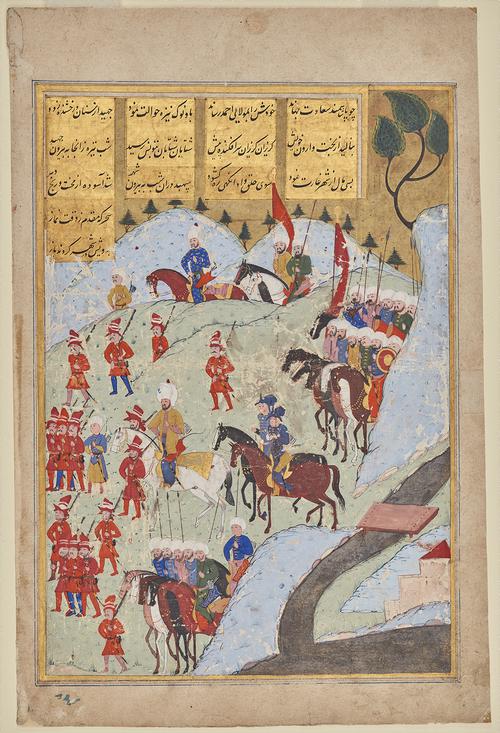
AKM215, The Conquest of Tunisia,
© The Aga Khan Museum
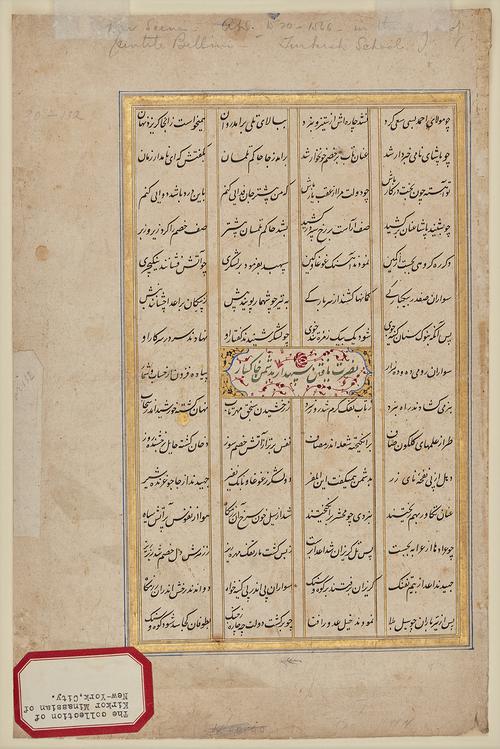
AKM215, The Conquest of Tunisia
© The Aga Khan Museum
Click on the image to zoom

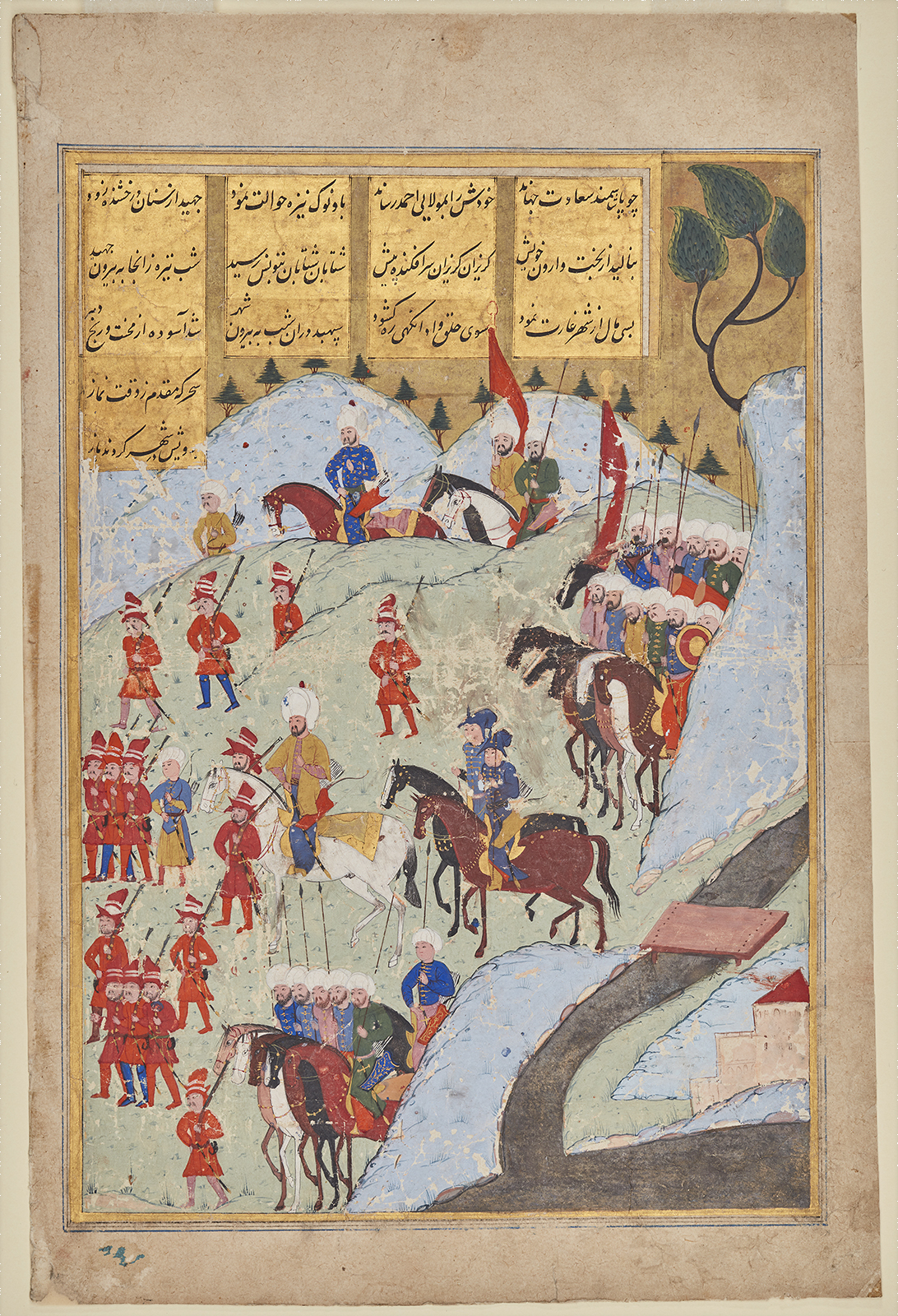
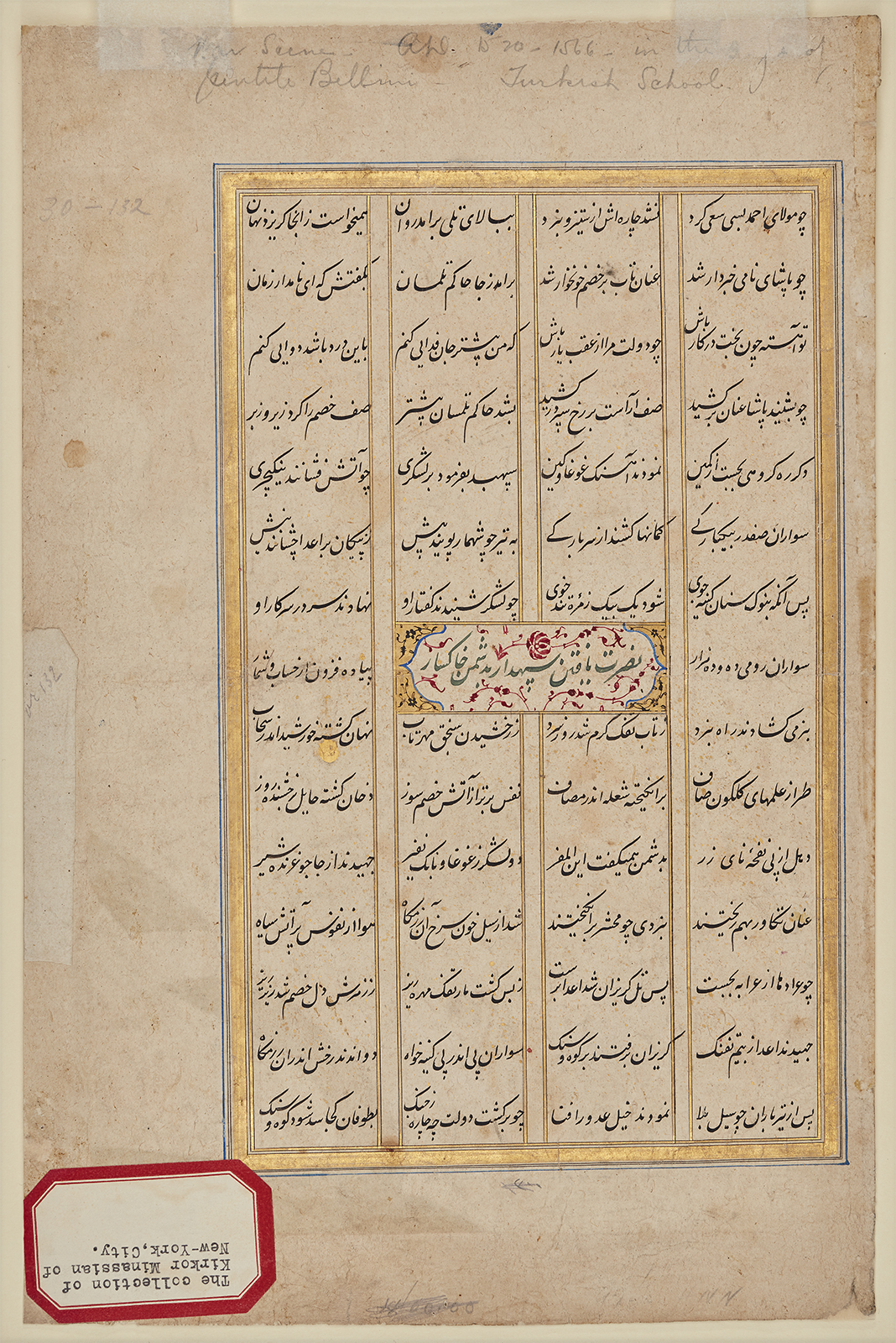
The Conquest of Tunisia
- Accession Number:AKM215
- Creator:Artist (painter): `Ali Artist (painter): Naqqas Osman Author: Lokman Scribe: Ilyas Katib
- Place:Turkey, Istanbul
- Dimensions:33 cm x 22 cm
- Date:12 January 1581 CE/6 Dhu'l-Hijja 988 AH/AH 988
- Materials and Technique:Opaque watercolour, ink, and gold on paper
This painting is part of a double-page composition depicting the 1569 Ottoman reconquest of the city of Tunis, as described in the accompanying text. The manuscript to which this folio belongs is a history of the reign of the Ottoman monarch Selim II (r. 1566–74) written by the court historian Lokman.
Further Reading
Lokman was Ottoman court historian between 1569 and 1595, serving under the sultans Selim II (r. 1566–74) and Murad III (r. 1574–95). Soon after completing the Zafername, an account of the Ottoman military campaign in Szigetvár, he was assigned to the Şehname-i Selim Han, a record of the reign of Selim II. Work would stretch over a decade as he painstakingly rendered the chronicle in the metre and verse of the Shahnameh, the Persian epic that had been composed some five hundred years earlier by the poet Firdausi. In the preface to this text, Lokman mentions the roles of key figures at court in initiating and guiding the writing process. These include şeyhülislam (the highest religious official) Ebussuud Efendi, the grand vizier Sokollu Mehmed Pasha (d. 1579), and Sokollu’s secretary Feridun Ahmed.[1]
The preface also informs us that when the text was completed in 1581, during the reign of Murad III, a deluxe copy of the work was made and illustrated by the artists Nakkaş Osman and ‘Ali. The extensive preface, along with preparatory drafts of the manuscript (including alternate versions of the text, sample illustrations, and/or instructions for the final layout) are invaluable documents for illuminating how the project was conceived and executed. Today, the main part of the manuscript is in the Topkapı Palace Museum (A. 3595); this is one of a small number of folios now in outside collections.[2]
This painting, attributed to ‘Ali, once faced folio 65a (which remains in the manuscript), forming a double-page composition.[3] Together they depict a 1569 march on the city of Tunis, as described in a section of the text about campaigns in Tunisia and Cyprus led by ‘Ali Pasha (1519–87; then governor of Algiers) and Sinan Pasha (ca. 1488–1588; general, famed court architect, and later grand vizier). On the right side of the composition (AKM215) is ‘Ali Pasha, dressed in a golden caftan and seated on a white steed. He and his janissary forces outfitted in red have just crossed a river and arrived at the city of Tunis. On the left side of the composition (A. 3595, fol. 65a) can be seen Muley Ahmad III (r. 1543–73), the Hafsid ruler of Tunis. He and his entourage stand outside the city walls in apparent surrender. Both figures are named at the top of AKM215, where the text has been carefully arranged to identify the protagonists of the painting.[4]
- Marika Sardar
Notes
1. For a discussion of the manuscript as a whole, see Filiz Çağman, “Şehname-i Selim Han ve Minyatürleri,” Sanat Tarihi Yıllığı (1972-73): 411-42; Nurhan Atasoy and Filiz Çağman, Turkish Miniature Painting (Istanbul: R.C.D. Cultural Institute, 1974), 34–36 and pl. 14–16; Serpil Bağcı, Filiz Çağman, Günsel Renda, and Zeren Tanındı, Ottoman Painting (Istanbul: Isbank Culture Publication, 2010), 123–27; and Emine Fetvacı, “The Production of the Şehname-i Selim Han,” Muqarnas 26 (2009): 263–315.
2. Fetvacı, “The Production of the Şehname-i Selim Han," 263–67. For the artists see Bağcı, Çağman, Renda, and Tanındı, Ottoman Painting, 123–27.
3. When published earlier, this folio was labeled 65a and its identification attributed to Nurhan Atasoy. See Anthony Welch, Collection of Art, Prince Sadruddin Aga Khan (Geneva, privately printed 1978), vol. 3, 14–15; and Anthony Welch, "The Ottoman Army Marches on Tunis," in Anthony Welch and Stuart Cary Welch, Arts of the Islamic Book: The Collection of Prince Sadruddin Aga Khan (Ithaca, NY: Cornell University Press, 1982), 34–36. Atasoy, however, must have indicated that the AKM folio faced 65a, as the painting on the AKM folio is on the verso of the page and obviously faced the painting still in the manuscript, on the left-hand side of the opening.
4. For the incident, see, Andrew C. Hess, The Forgotten Frontier: A History of the Sixteenth Century Ibero-African Frontier (Chicago: University of Chicago Press, 1978), 88-90. For the arrangement of the text to fall on specific folios, see Fetvacı, “The Production of the Şehname-i Selim Han," 275–81.
References
Atasoy, Nurhan and Filiz Çağman. Turkish Miniature Painting. Istanbul: R.C.D. Cultural Institute, 1974. OCLC:282022253
Bağcı, Serpil, Filiz Çağman, Günsel Renda, and Zeren Tanındı. Ottoman Painting. Ankara: Republic of Turkey, Ministry of Culture and Tourism, Publications: Banks Association of Turkey, 2010. ISBN:9789751734990
Çağman, Filiz. “Şehname-i Selim Han ve Minyatürleri." Sanat Tarihi Yıllığı (1972–73): 411–42.
Fetvacı, Emine. “The Production of the Şehname-i Selim Han." Muqarnas 26 (2009): 263–315. ISBN:9789004175891
Hess, Andrew C. The Forgotten Frontier: A History of the Sixteenth Century Ibero-African Frontier. Chicago: University of Chicago Press, 1978. ISBN:9780226330303
Welch, Anthony. Collection of Art, Prince Sadruddin Aga Khan. Geneva, privately printed 1978. OCLC: 923113519
--- and Stuart Cary Welch. Arts of the Islamic Book: The Collection of Prince Sadruddin Aga Khan. Ithaca: Published for the Asia Society by Cornell University Press, 1982. ISBN: 9780801415487
Note: This online resource is reviewed and updated on an ongoing basis. We are committed to improving this information and will revise and update knowledge about this object as it becomes available.
