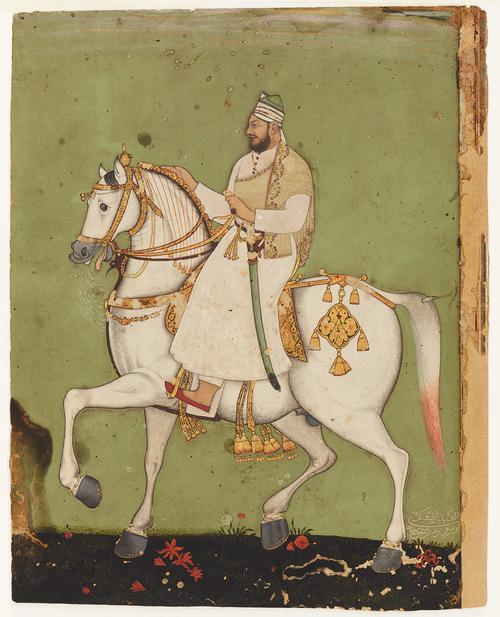
AKM922, Portrait of Shah Raju II
© The Aga Khan Museum
AKM922, Portrait of Shah Raju II, Back
© The Aga Khan Museum
Click on the image to zoom

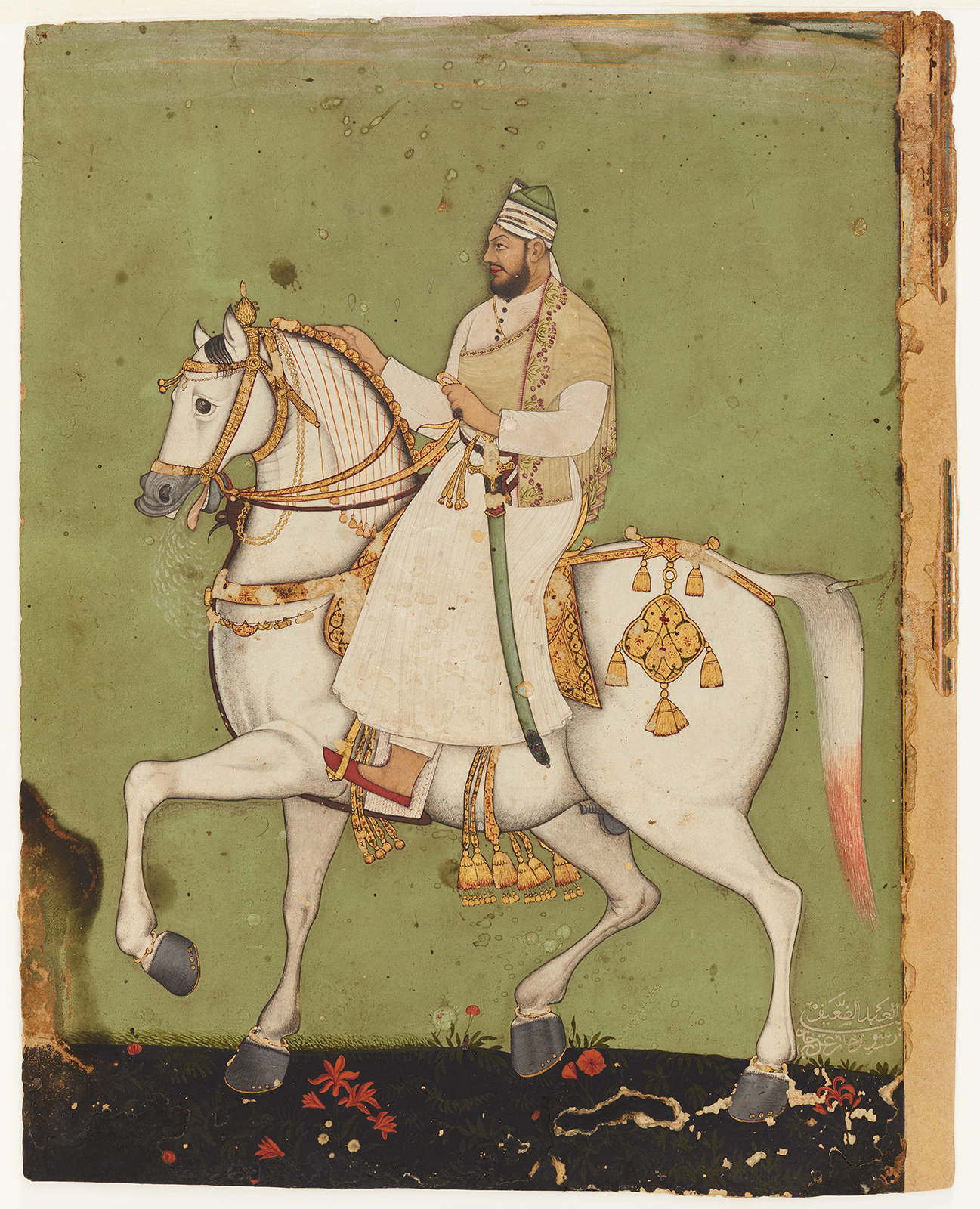
Portrait of Shah Raju II
- Accession Number:AKM922
- Creator:attributed to Rasul Khan
- Place:India, Deccan, Golconda
- Dimensions:24.3 x 18 cm
- Date:ca. 1670 – 80
- Materials and Technique:opaque watercolour on paper
Beginning in the late 16th century, portraits of rulers and their courts became a well-established genre in the art of Mughal India and the Deccan Sultanates. These portraits emphasized status and power by paying exacting attention to the trappings of wealth.
Further Reading
This portrait attributed to Rasul Khan is executed in a style influenced by both Mughal and Deccan portraiture (particularly that created in Bijapur). Complete with luxurious textiles, high-quality saddles, and richly decorated harness fittings, it depicts Shah Raju II, the spiritual guide of Sultan Abu’l Hasan of Golcanda, whose Deccan kingdom was famous for its diamond mines. In Raju’s mount, a powerful horse with graceful head and robust body, this painting also presents a masterful animal portrait. Naturalistic details such as steam emanating from the horse’s mouth emphasize the animal’s dynamism. In turn, they endow Raju himself with strength and nobility.
— Filiz Çakır Phillip
References
Canby, Sheila. Princes, Poets & Paladins: Islamic and Indian Paintings from the Collection of Prince and Princess Sadruddin Aga Khan. London: Trustees of the British Museum, 1998. ISBN: 9780714114835
Welch, Anthony, and Stuart Cary Welch. Arts of the Islamic Book: The Collection of Prince Sadruddin Aga Khan. Ithaca, NY: Cornell University Press, 1982. ISBN: 9780801498824
Note: This online resource is reviewed and updated on an ongoing basis. We are committed to improving this information and will revise and update knowledge about this object as it becomes available.
