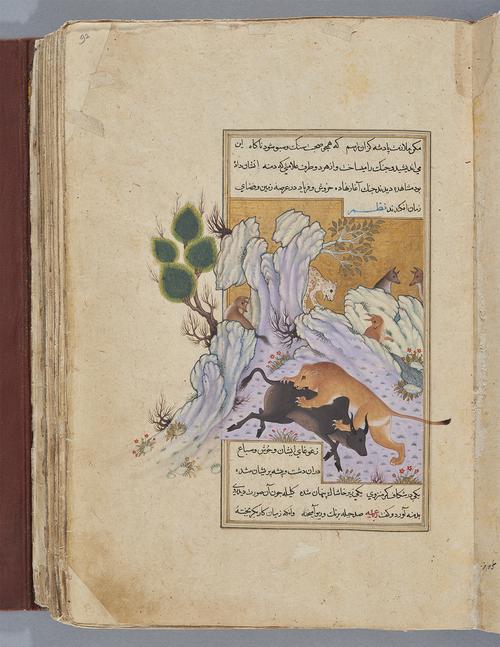
AKM289, Anvar-i Suhayli (The lights of Canopus), fol.92r
© The Aga Khan Museum
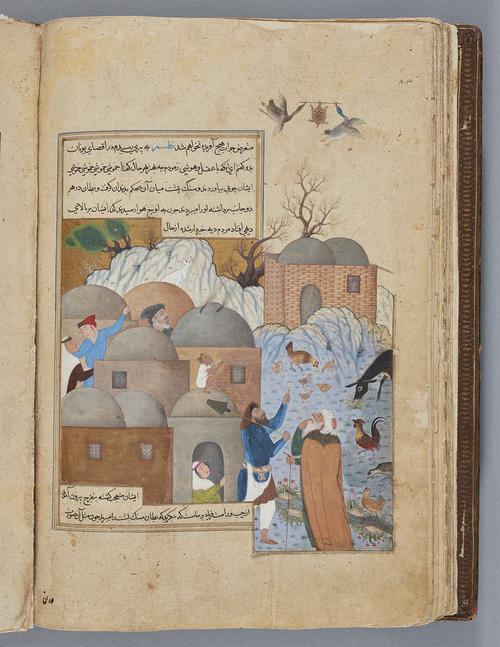
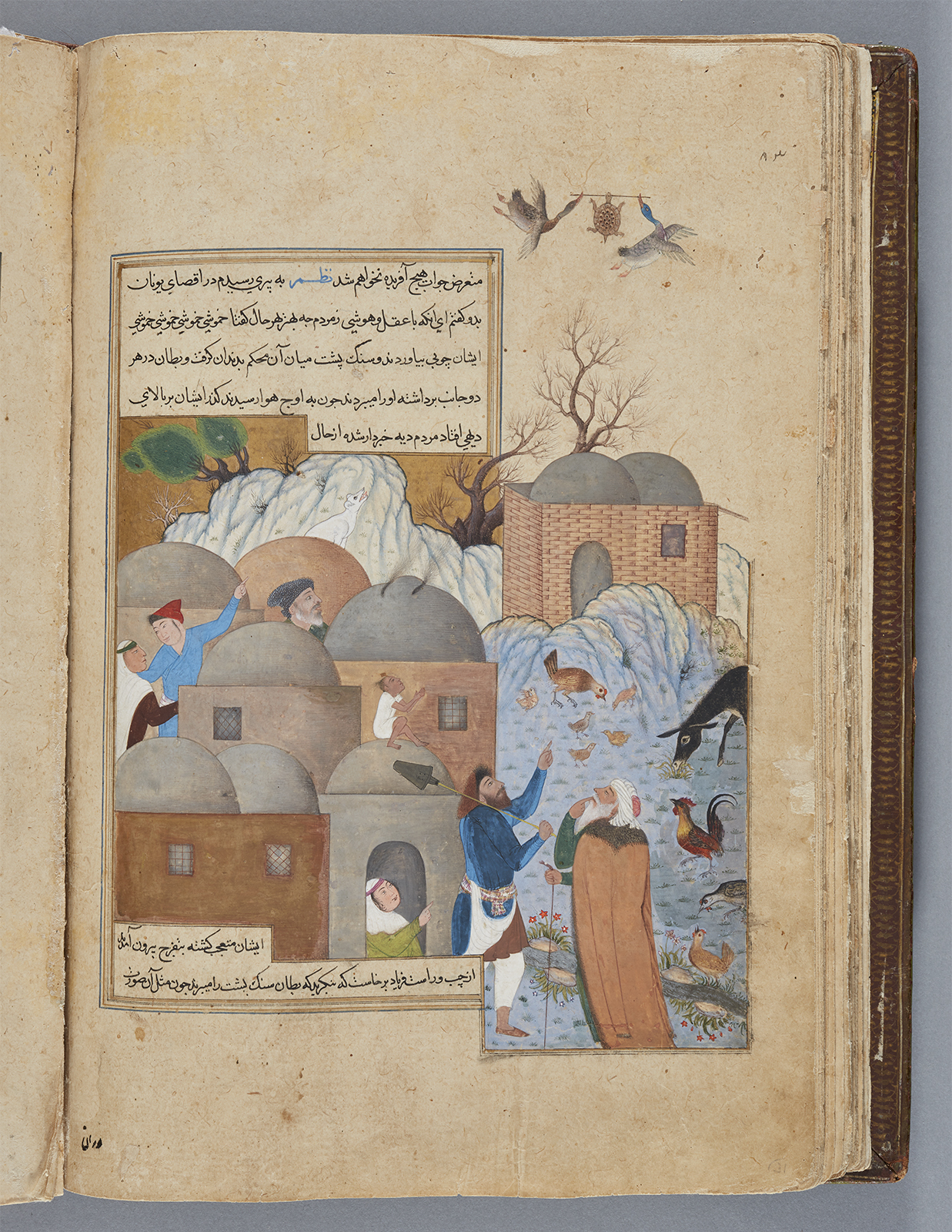
AKM289, Anvar-i Suhayli (The lights of Canopus), fol.89v
© The Aga Khan Museum
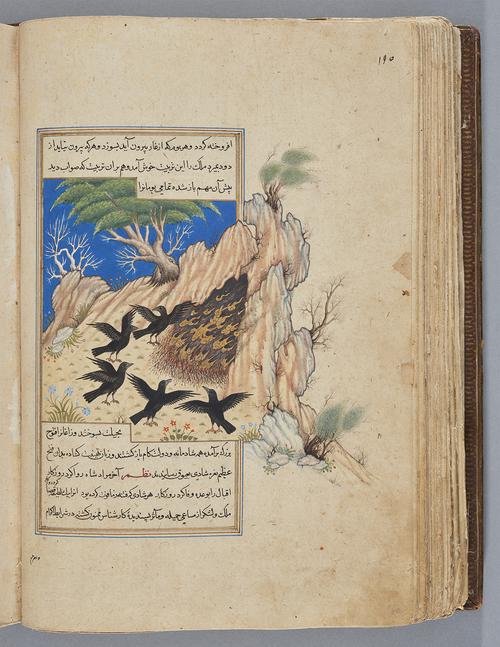
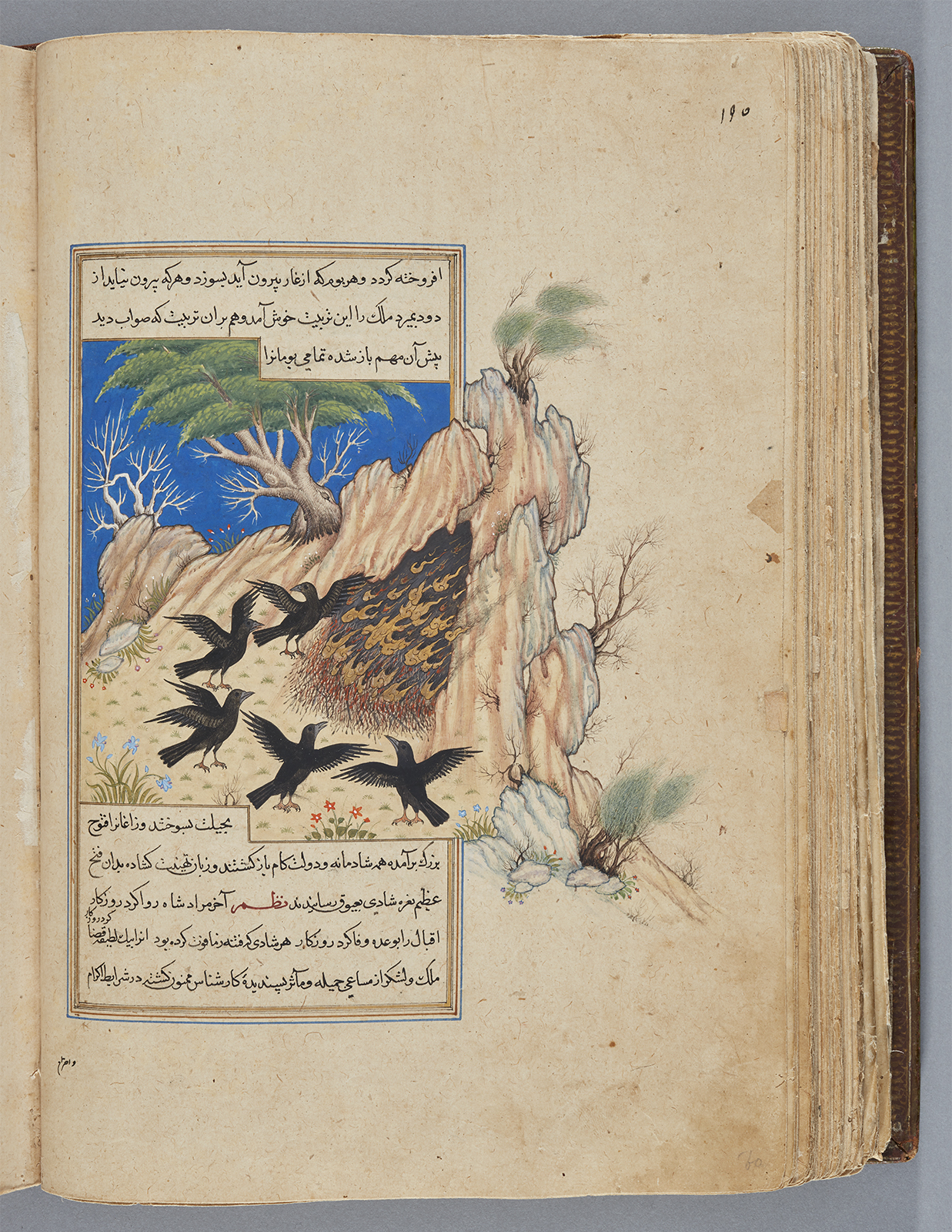
AKM289, Anvar-i Suhayli (The lights of Canopus), fol.201v
© The Aga Khan Museum
Click on the image to zoom

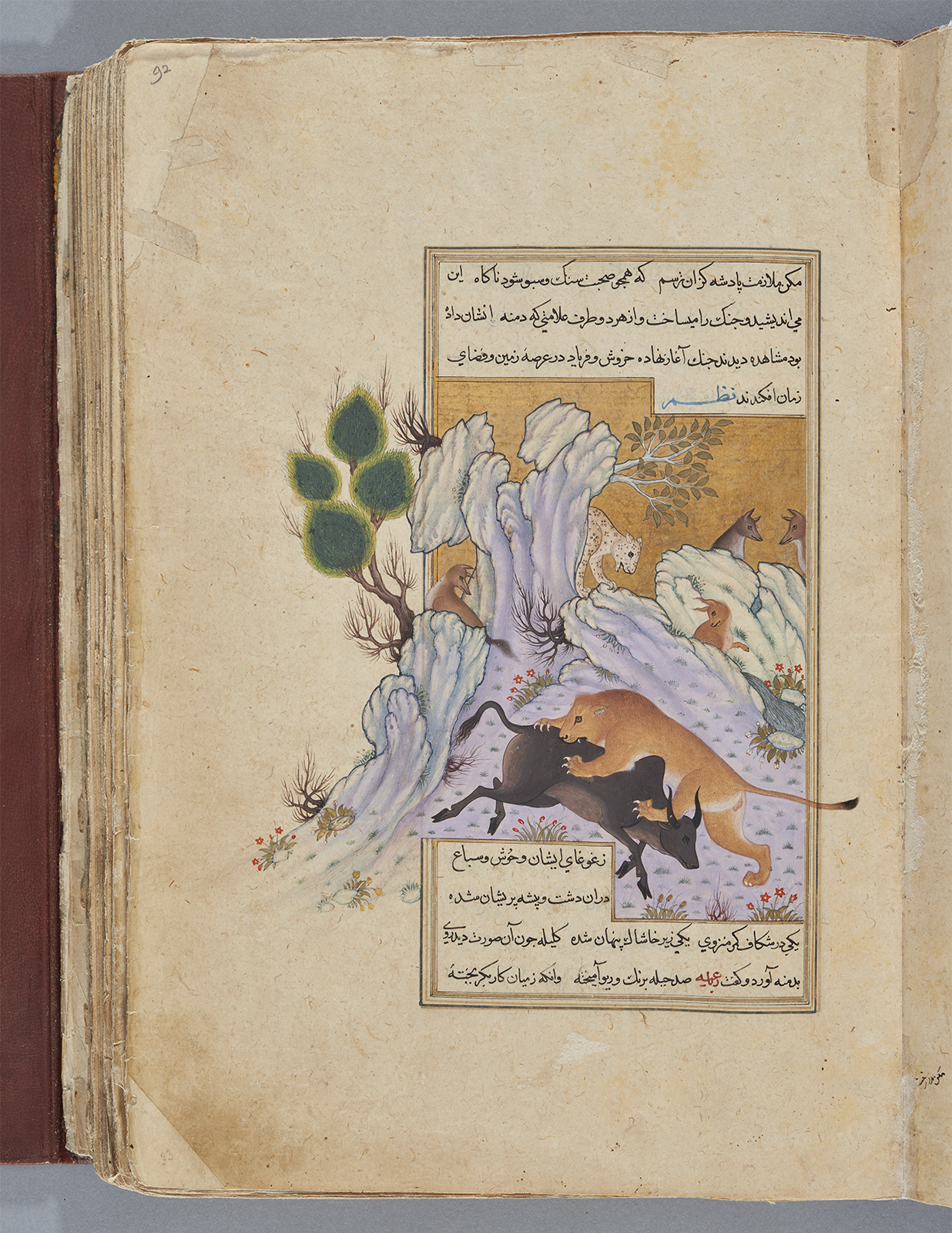
Manuscript of The Lights of Canopus (Anvar-i Suhayli)
- Accession Number:AKM289
- Creator:Artist (painter): Sadiqi, Persian, died 1612
Author: Husayn b. `Ali al-Wa`iz al-Kashifi
Scribe: Na`im Muhammad al-Husayni al-Tabrizi
Translated by: Kashefi, died 1504 - 1505 - Place:Iran
- Dimensions:30.1 cm x 20.3 cm x 8 cm
- Date:8 November 1593 CE/13 Safar 1002 AH
- Materials and Technique:ink, opaque watercolour, and gold on paper
Anvar-i Suhayli belongs to the cycle of Kalilah and Dimnah animal tales that are believed to have originated in the Sanskrit Pancatantra, which made its way to Iran during the rule of the Sasanian kings (224–651). These tales about two crafty jackals named Kalilah and Dimnah gave rise to an extensive and hugely popular literary genre based on the all-too-human interactions among various members of the animal kingdom. The Kalilah and Dimnah tales reached Europe via Hebrew and Old Spanish translations and these were subsequently translated and adapted into virtually all European languages. Not really intended for children (except in later expurgated versions), the Kalilah and Dimnah tales and others narrated within the frame-tale served a didactic purpose, as advice intended chiefly for rulers and courtiers, but also for a wider public.
Further Reading
Anvar-i Suhayli is a masterful rewriting of Nasrullah Munshi’s somewhat dated Persian version of Kalilah and Dimnah by Kamal al-Din Husayn b. ‘Ali. Known as Kashifi (“The unveiler”) (ca. 1426–1504), Kamal al-Din Husayn was a prolific Iranian author, preacher, and polymath who lived in Herat (in present-day Afghanistan) in the second half of the 15th century during the rule of Sultan-Husayn Bayqara Mirza, a descendant of Tamerlane. He may have composed the work in 1499–1500, and he dedicated it to the Timurid amir Nizam al-Din Shaykh-Ahmad Suhayli, whose name is alluded to in the title. The title can be read two ways: as “Lights like those of Canopus” (Canopus being the brightest star in the southern hemisphere) or as “Insights presented to Amir Suhayli.” Kashifi gave his Anvar-i Suhayli more of a Persian flavour by introducing the precepts of the mythical Iranian king Hushang as the titles of the fourteen chapters instead of Nasrullah Munshi’s Arabic headings, and he substituted Nasrullah Munshi’s Arabic verses with Persian ones. Anvar-i Suhayli immediately became the dominant version of the Kalilah and Dimnah tales in the Persianate cultural sphere. It was translated, in turn, into Turkish in the early 16th century as Humayun-nama (The royal book) by ‘Ali Çelebi (d. 1543) and dedicated to the Ottoman sultan Süleyman the Magnificent. A more concise Persian version was composed in 1588 for the Mughal Indian ruler Akbar under the title ‘Ayar-i danish (The assay of wisdom) by the historian and bureaucrat Abu’l Fazl ‘Allami.
Anvar-i Suhayli is a mirror for princes that provides advice on the art of governance and on the ethical qualities a king should possess in order to be regarded as a “just ruler.” The author states that “it will prove useful to kings in governing their subjects and spreading out the carpet of justice and clemency; in educating and strengthening the grandees of the state; and in preventing enemies from encroaching upon the kingdom.” The work is organized in the form of a frame-tale in which a mythical ruler named Humayun-fal (“Royal good omen”) discusses the fundamentals of political philosophy with his minister Khujastah-ray (“Auspicious counsel”). Khujastah-ray advises Humayun-fal to act like the Indian rajah Dabshalim who ruled according to the wise precepts of his advisor, the Brahmin sage Bidpay. The fourteen chapters within this frame contain their own frame-tales devoted to such topics as avoiding slanderers, choosing suitable friends, being on guard against one’s enemies, the merits of clemency, and accepting one’s fate in life. Each chapter is illustrated by means of a lead story into which are nested other tales illustrative of various aspects of it. All in all, there are 107 stories, mostly, although not exclusively, about animals.
Anvar-i Suhayli became extremely popular, with hundreds of manuscript copies in existence, some of which were illustrated. The manuscript in the Aga Khan Museum Collection (AKM289) is undoubtedly the finest illustrated manuscript of the work in existence, with virtually every story being illustrated with beautiful paintings. It was copied in Qazvin, Iran, in 1593 by Na‘im Muhammad al-Husayni al-Tabrizi and illustrated in the atelier of the famous artist Sadiqi Beg (d. 1612) during the reign of the Safavid Shah ‘Abbas I (r. 1587–1629).
The Lion and the Bull, the frame-story of the first chapter on avoiding slanderers, is a grim cautionary tale about how a treacherous self-seeking outsider, the jackal Dimnah, insinuated his way into the confidence of the Lion king and, thanks to his devious machinations, caused a rift between him and his dear friend, the Bull Shanzabah, with the unfortunate result that the Lion, convinced by Dimnah’s smoothing-talking, ended up killing the Bull (Illustration fol. 92r). This story is presented in an accessible English adaptation, with illustrations from the Aga Khan Museum manuscript, by Elizabeth Laird in Two Crafty Jackals: The Animal Fables of Kalilah and Dimnah (2013).
Even more grim is the story of the Owls and the Crows, which dominates chapter four on always being vigilant against one’s enemies. The Crows lived in perpetual fear of their traditional enemies, the Owls, who one night attacked their dwelling, killing many. The king of the Crows consulted with his ministers about how to respond to this outrage, and in the end accepted a devious stratagem proposed by the minister Karshinas (“Experienced”) whereby the king would feign being angry with him and order his feathers to be plucked out, leaving him wounded and bleeding under his own nest. When the Owls, who were planning another attack, came upon the wounded Karshinas, they deliberated about what to do with him. Despite the reservations of one of his ministers, the Owl king accepted Karshinas’s story and allowed him to live among them. Karshinas managed to gain the Owls’ trust and learned all their secrets, including the location of the cave where they slept during the day. He then conspired with his fellow Crows to set fire to the entrance of the cave, thereby annihilating the entire community (Illustration fol. 201v).
But there are also tales of a milder nature that are used as illustrations of advice offered by various characters, such as the tale of the Tortoise and the Ducks in the frame-story of the Lion and the Bull. When her pond dried up due to a drought, the Tortoise appealed to her fellow inhabitants, the Ducks, who were planning to fly away to another location. Employing flattering speech combined with protestations of weakness, the Tortoise convinced the Ducks to find a solution to her dilemma. They suggested carrying her hanging from a stick, which she would grasp with her beak, on condition that she promised to remain silent (Illustration fol. 89v). When she was spotted by a crowd of amazed onlookers, she became upset by their shouts and opened her mouth to mock them for stating the obvious. The consequences turned out to be fatal, as she lost her grip on the stick and crashed down to the ground. The moral of the story is given as “Whoever does not heed the admonition of friends will only bring about his own destruction.” However, this is prefaced by the oft-quoted Qur’anic verse, “The duty of the messenger is just to deliver the message,” by which the Ducks sought to exonerate themselves from not explaining to the Tortoise exactly why she should have remained silent. For her part, the Tortoise should have inquired about the reasons for the advice the Ducks gave her and not just believed them to be well-wishing friends. And finally, there is the Tortoise’s acute sense of self-esteem that got the better of her when she heard the people shouting and pointing at her. Even this seemingly simple tale enfolds a moral conundrum.
Translated into Middle Persian in the 6th century, the tales of Kalilah and Dimnah were also translated into Syriac, and in the 8th century, under Islamic caliphal rule, into Arabic by the renowned Iranian translator Ibn al-Muqaffa‘(d. 757). Most of these versions have been lost, including the original version of the Pancatantra (if in fact such an original version ever existed), making it difficult to trace the transmission history. In the 12th century, Ibn al-Muqaffa‘s Arabic translation was translated into New Persian (i.e., the Persian of the Islamic period) by Nasrullah Munshi (d. ca. 1159), a professional chancery scribe, for the Ghaznavid ruler Bahram Shah in eastern Iran (although “translation” does not do justice to Nasrullah’s innovative literary version). Scholars have been debating the relationship between the Sanskrit, Middle Persian, Syriac, Arabic, and New Persian translated versions and retranslations for decades.
— Maria Subtelny
References
Eastwick, E. B., trans. Anvar-i Suhaili or The Lights of Canopus. Hertford: Stephen Austin, 1854.
Laird, Elizabeth. Two Crafty Jackals: The Animal Fables of Kalilah and Dimnah. Toronto: Aga Khan Museum, 2013. ISBN: 9780991992812
van Ruymbeke, Christine. Kashefi’s Anvar-e Sohayli: Rewriting Kalila and Dimna in Timurid Herat. Leiden: Brill, 2016. ISBN: 9789004310285
Note: This online resource is reviewed and updated on an ongoing basis. We are committed to improving this information and will revise and update knowledge about this object as it becomes available.
