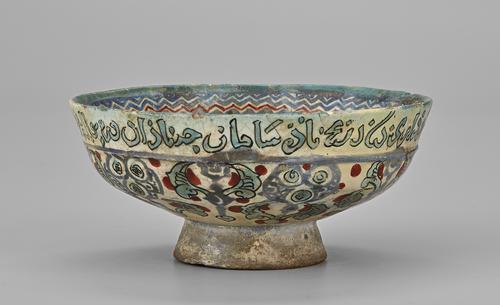
AKM790, Bowl depicting Bahram Gur and Azadeh, Side
© The Aga Khan Museum
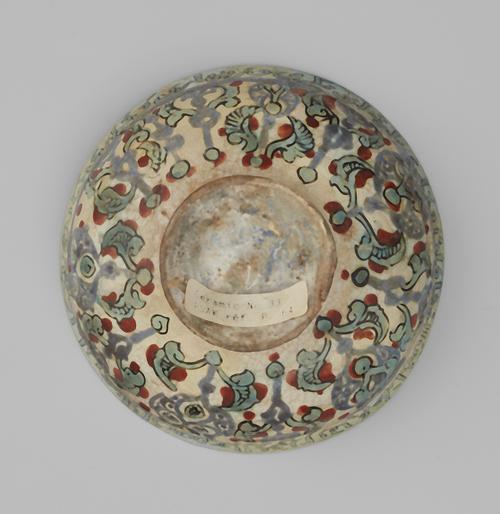
AKM790, Bowl depicting Bahram Gur and Azadeh, Bottom
© The Aga Khan Museum
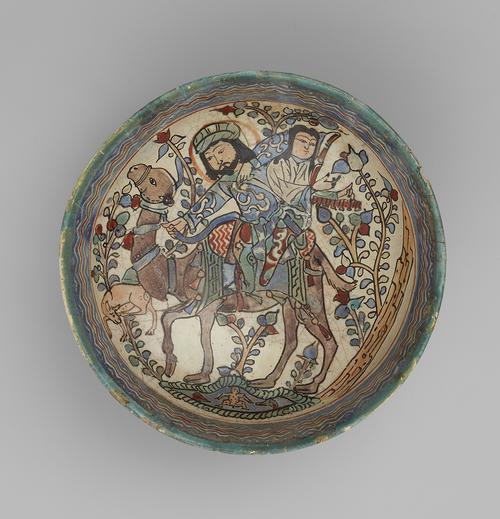
AKM790, Bowl depicting Bahram Gur and Azadeh, Top
© The Aga Khan Museum
Click on the image to zoom

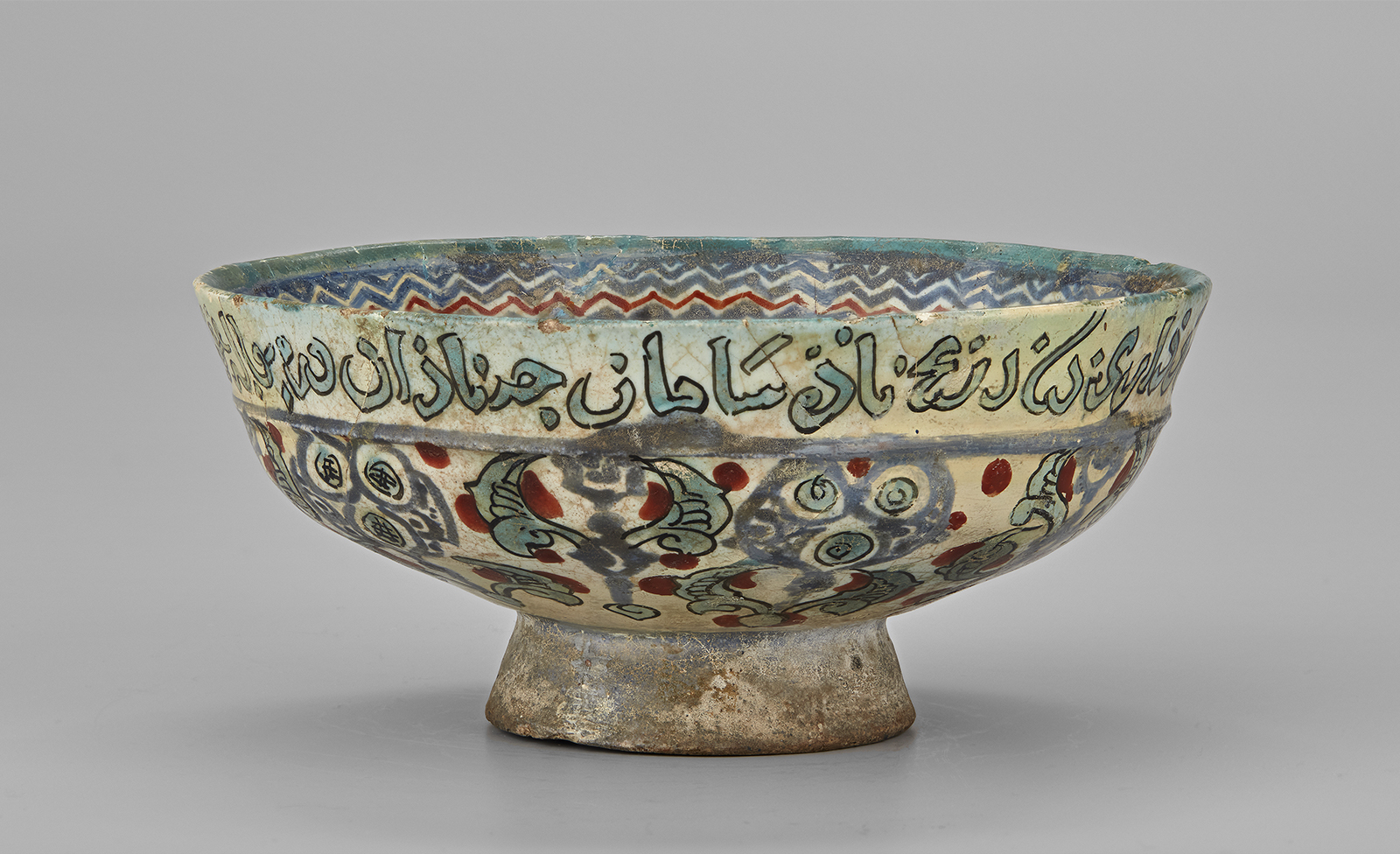
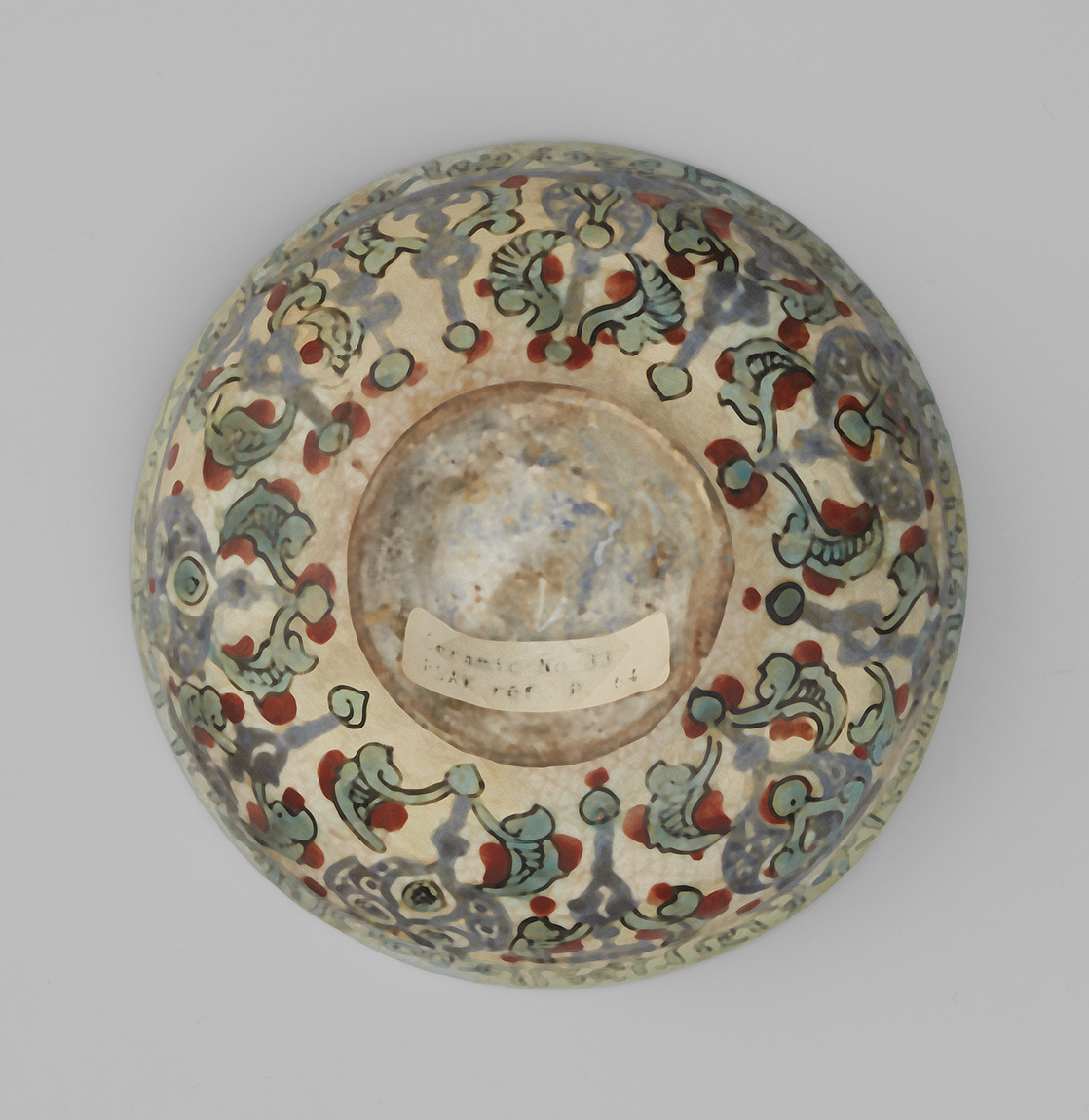
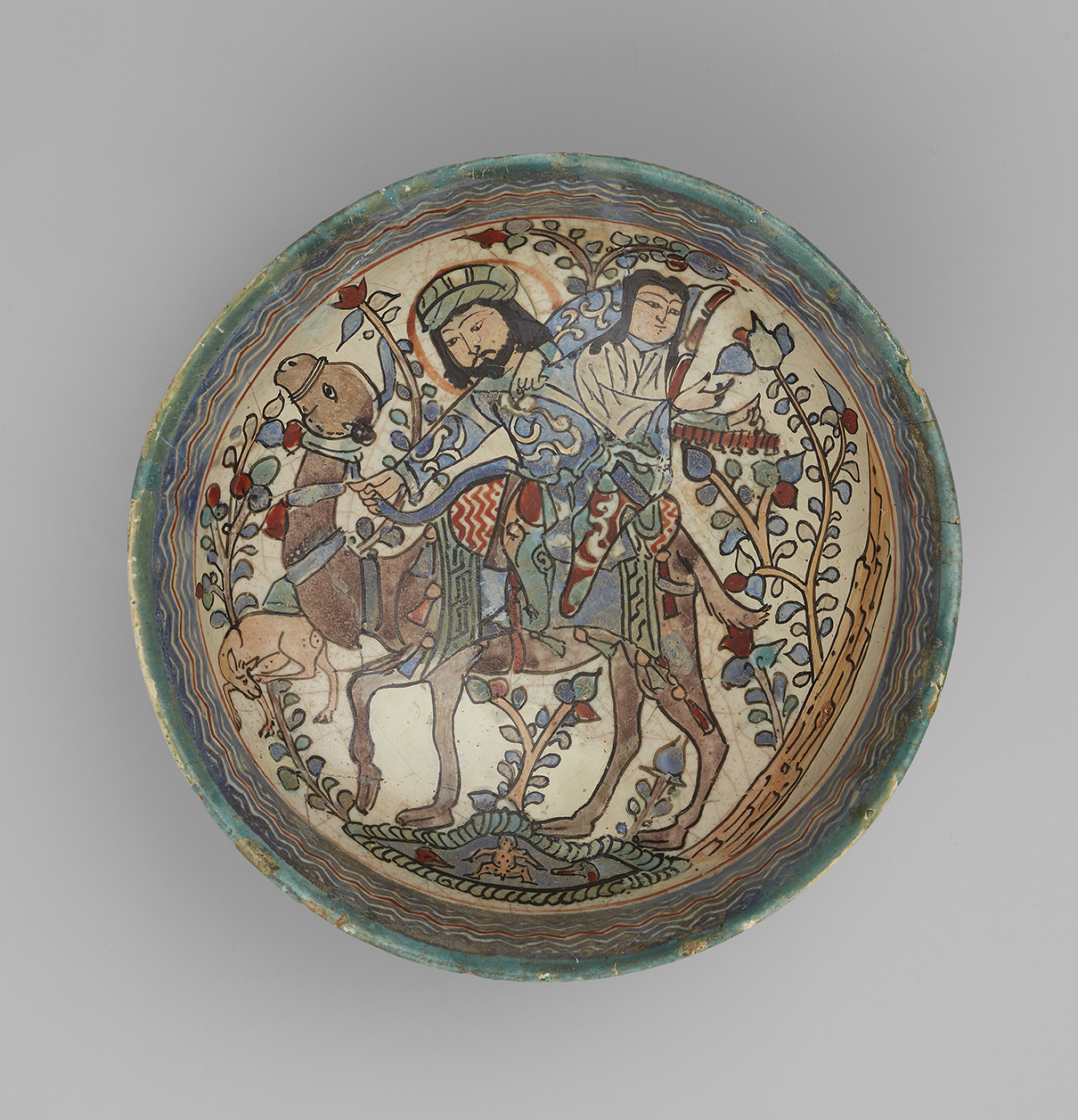
Bowl depicting Bahram Gur and Azadeh
- Accession Number:AKM790
- Place:Iran
- Dimensions:5.5 cm × 12 cm
- Date:late 12th to early 13th Century
- Materials and Technique:Fritware, opaque monochrome glaze with polychrome inglaze and overglaze decoration (mina’i ware)
This small bowl depicts a vignette from the story of king Bahram Gur and his consort Azadeh. They are riding on a camel, he shooting an arrow and she playing the harp. The bowl has been decorated in the mina’i, or enamel, technique, which involves applying glazes that require different levels of heat in separate stages. The glazes set at a higher temperature are painted in first, the object is fired in the kiln, and then the colours requiring a lower temperature are applied over this now-hardened surface before the object is fired again. The process was described in a 14th-century treatise by Abu’l Qasim Kashani, by whose time the practice had apparently died out. According to the latest scholarship, all mina’i production took place in the brief period between the end of the twelfth century and the start of the thirteenth century.[1]
Further Reading
Bahram Gur was a historic figure—King Bahram V of the Sasanian dynasty (r. 420–38)—who was popular as a monarch and much mythologized in literature. Various works of fiction ascribe legends to him, including the Shahnameh (The Book of Kings) of Firdausi in the early 11th century, the Haft Paykar (The Seven Beauties) of Nizami in the late 12th century, and the Hasht Behisht (The Eight Heavens) of Amir Khusrau in the early 14th century. Firdausi presents him as a wise and just ruler, but Nizami and Amir Khusrau choose to emphasize his amorous exploits, in stories in which he seduces a series of princesses.[2]
The story on this bowl speaks to Bahram Gur’s skill in hunting, and depicts an incident that took place when Bahram was still a prince. One day he went hunting with a female slave named Azadeh, who challenged him to turn a male deer into a female deer and a female deer into a male deer. He accomplished this feat by knocking the antlers off the male and shooting two arrows into the head of the female. His prowess, especially in hunting gur (a type of wild ass), earned him the name Bahram-i Gur, Bahram of the gur.[3]
- Marika Sardar
Notes
1. Margaret S. Graves, "KASHAN vii. Kashan Ware," Encyclopaedia Iranica, online edition, 2014, available at https://www.iranicaonline.org/articles/kashan-vii-kashan-ware and Kerith Koss et al., "Analysis of Persian Painted Minai Ware," in Blythe Ellen McCarthy, ed., Scientific Research on Historic Asian Ceramics: Proceedings of the Fourth Forbes Symposium at the Freer Gallery of Art (London, 2009), 33–47.
2. W.L. Hanaway, Jr., "Bahram V Gor in Persian Legend and Literature," Encyclopaedia Iranica, III/5, 514–22, www.iranicaonline.org/articles/bahram-05-lit.
3. Firdausi, Dick Davis, and Azar Nafisi, Shahnameh: The Persian Book of Kings (New York: Penguin, 2007), 604–05.
References
Firdausi, Dick Davis, and Azar Nafisi. Shahnameh: The Persian Book of Kings. New York: Penguin, 2007. ISBN:9780143104933
Graves, Margaret S. "KASHAN vii. Kashan Ware." Encyclopaedia Iranica, online edition, 2014
Hanaway, Jr., W.L. "Bahram V Gor in Persian Legend and Literature." Encyclopaedia Iranica, III/5, 514–22
Koss, Kerith et al. "Analysis of Persian Painted Minai Ware," in Blythe Ellen McCarthy, ed., Scientific Research on Historic Asian Ceramics: Proceedings of the Fourth Forbes Symposium at the Freer Gallery of Art, 33–47. London: Archetype, 2009. ISBN:9781904982463
Note: This online resource is reviewed and updated on an ongoing basis. We are committed to improving this information and will revise and update knowledge about this object as it becomes available.
