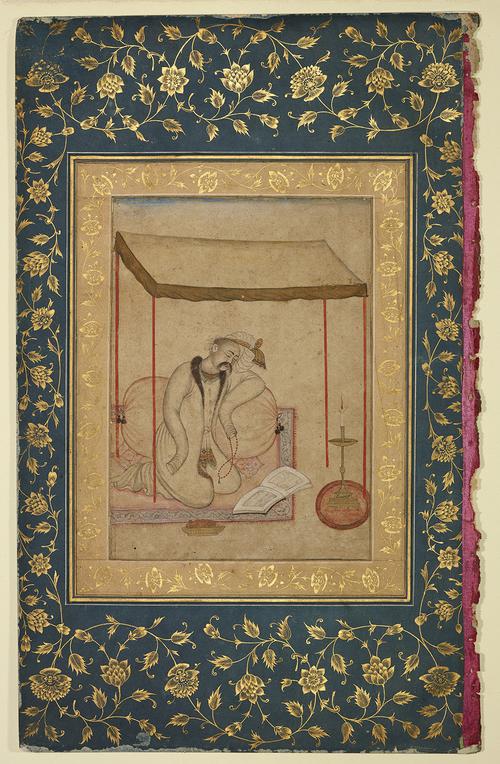
AKM201, A Drowsy Courtier Reading by Candlelight
© The Aga Khan Museum
Click on the image to zoom

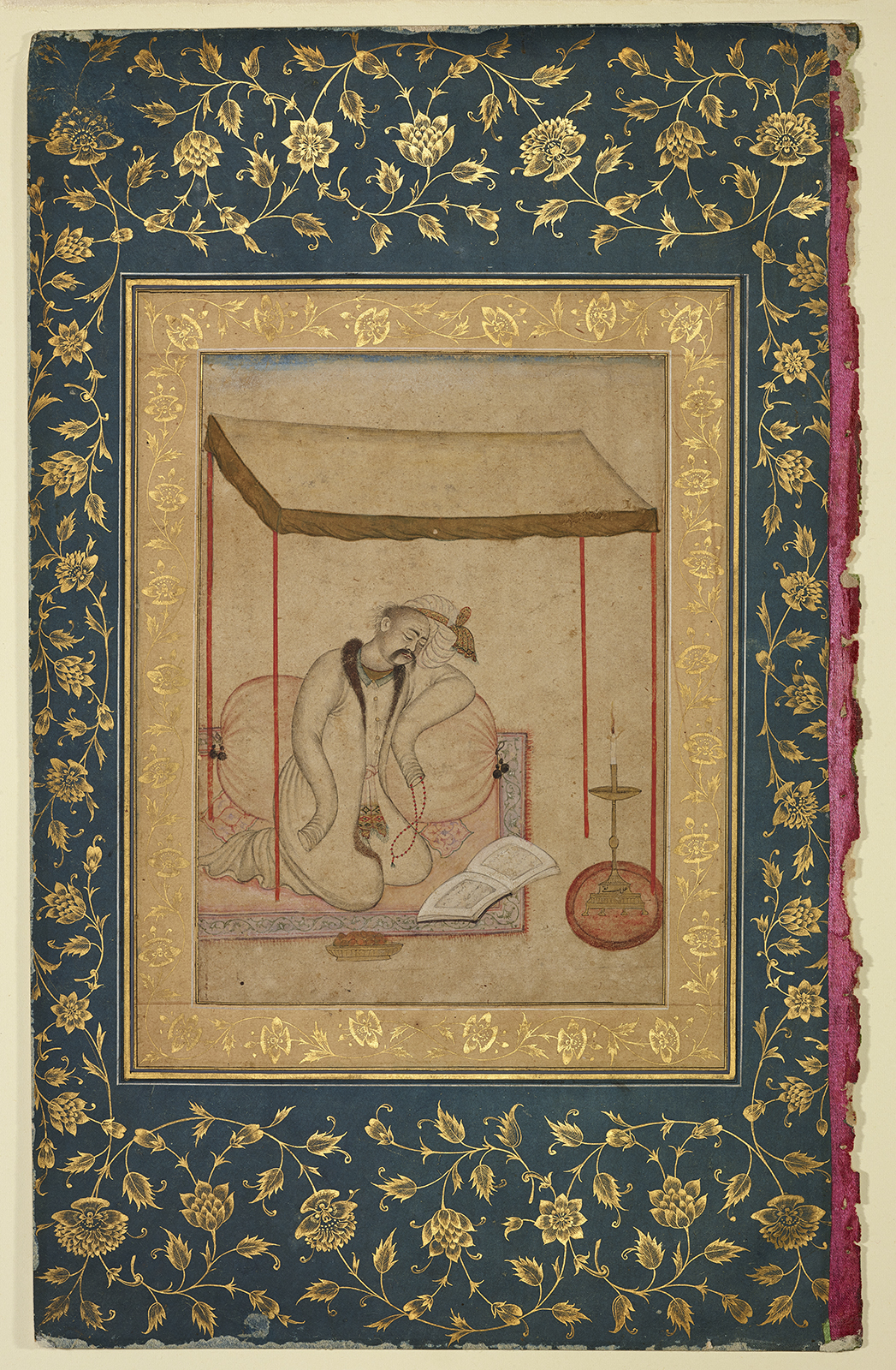
A Drowsy Courtier Reading by Candlelight
- Accession Number:AKM201
- Creator:signed by Naqi
- Place:India, Deccan
- Dimensions:35.2 x 22.4 cm
- Date:ca. 1630
- Materials and Technique:ink, opaque watercolour, and gold on paper
This single-page tinted drawing shows a drowsy man sitting under a canopy. He leans back against a large cushion while clutching red prayer beads in his left hand. The canopy could be a later addition or a miscalculation by the artist, since one stake stands on the tablet of the candlestick. This intimate scene depicts a courtier, perhaps a scholar. He fights against sleep while still trying to read the book by candlelight. His sliding turban, the drooping sleeves of his fur-trimmed coat, and his closing eyes are evidence of his drowsiness. An inscription on the base of the candlestick with the signature of the artist, amal Naqi (the work of Naqi), can be seen.
Further Reading
During the first half of the 17th century, the Mughals were still powerful across the Indian subcontinent, including the Deccan. However, apart from Mughal Indian culture, the strongest cultural influence on Deccani art was Iranian. The three sultanates of the Deccan—Ahmadnagar, Bijapur, and Golconda—were influenced by additional artistic developments, as Deccani rulers also retained strong ties with the Ottomans and Uzbeks.[1]
In this drawing from the Aga Khan Museum Collection, objects such as the cushion seem to be in the Indian style. Iranian influences are present in the silhouette of the figure and the extra-long sleeves of his coat. These latter details are also evidence that the Iranian style introduced by artist Reza-e ‘Abbasi was widespread even in India. Reza-e ‘Abbasi (ca. 1565–1635) had an enormous impact on 17th-century artists. His numerous students and followers imitated his style of drawing as well as his topics. The drawings of daily life in nature in the Reza-e ‘Abbasi Album demonstrate his draftsmanship and superlative creativity.
— Filiz Çakır Phillip
Notes
[1] Stuart Cary Welch, Wonders of the Age: Masterpieces of Early Safavid Painting, 1501–1576 (Cambridge, MA: Fogg Art Museum, Harvard University, 1979), 20.
References
Phillip, Filiz Çakır. Enchanted lines: drawings from the Aga Khan Museum collection. 2014. ISBN: 9780991992874
Welch, Stuart Cary. Wonders of the Age: Masterpieces of Early Safavid Painting, 1501–1576. Cambridge, MA: Fogg Art Museum, Harvard University, 1979. ISBN: 9780916724382
Note: This online resource is reviewed and updated on an ongoing basis. We are committed to improving this information and will revise and update knowledge about this object as it becomes available.
